
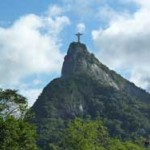
 At that time, Santo Antônio Hill (in Rio de Janeiro downtown) and Sugar Loaf were also considered as possible locations. In the end, Corcovado Mountain was chosen because it was the highest pedestal in Rio de Janeiro and was thus deemed the perfect place for the statue of Christ. Note that Corcovado at 710 metres (2,328 feet) is not the highest peak in Rio; the highest one is Pico da Pedra Branca (white stone peak) at 1,024 metres (3,358 feet) above sea level.
Heitor da Silva Costa, the engineer-architect responsible for the project, decided that the face of the statue should be turned toward Botafogo Beach (East), because from there, Corcovado Mountain looked more beautiful and perpendicular, serving as a natural pedestal, which in Costa’s view seemed ideal. Moreover, those who arrived in Rio by boat via Guanabara Bay would see the face and front of the statue.
By the way, if a line were drawn from the statue’s face, it would cross the Atlantic and make land fall on the the coast of Namibia in Africa.

For more relevant historic information on Christ, get a copy of Christ the Redeemer Statue – A Comprehensive Guidebook to Visiting the Rio de Janeiro Landmark atop Corcovado Mountain.
Read related articles:
How did the material get to the Corcovado summit?
Where did the idea to build the Christ statue in Rio come from?
How long did it take to build Christ the Redeemer statue?