
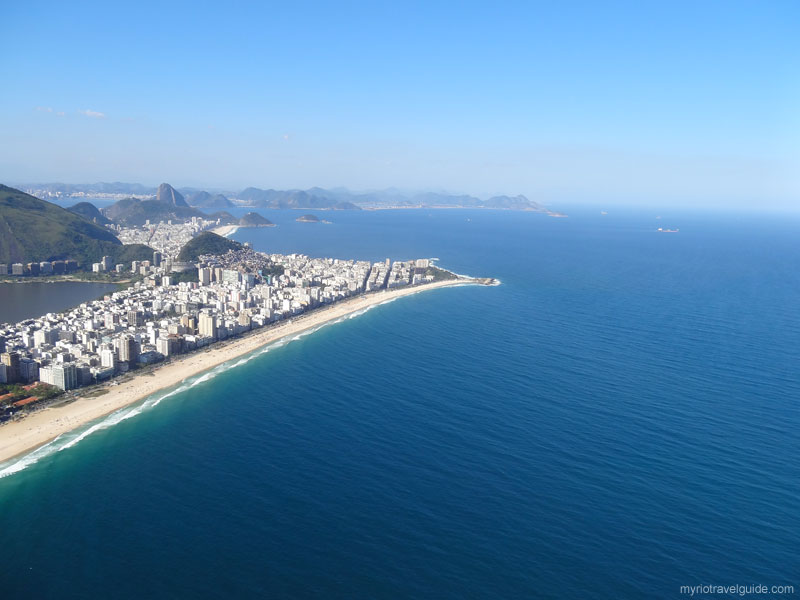
 Aerial view of Ipanema and Arpoador beaches.
Rio de Janeiro beaches compete with the best city beaches in the world. In Rio alone there are 27 beaches, but in the Rio de Janeiro State there are more than 100! If you are a praia (beach) lover, Rio de Janeiro will be a paradise for you as there is an undeniably beach culture.
Here are a few things that many Rio de Janeiro beaches have in common:
- Getting a good tan (without getting sunburned) is extremely popular among the locals
- The water is cold (for Brazilian standards): around 20 celsius (68 fahrenheit)
- You can lounge anywhere with your towel or beach sarong, or you can rent a chair and/or a parasol
- The weather is usually good all year around, including in the autumn, spring and winter!
- Most beaches are clean (at least the ones listed in this article)
- Sunbathing topless is forbidden in Rio de Janeiro (and throughout Brazil); a two-piece bikini is the standard for women, regardless of age and body shape
- For men the outfit is a Speedo or a beach short
- There are vendors selling all sorts of things on the beach, so bring some cash for beers, snacks, sunscreen, etc
- Shark attacks are very rare in Rio de Janeiro (but are common in the warm waters of Recife, Northeastern Brazil)
Below are the top 10 beaches worth-going within the city perimeter. Bear in mind that Rio de Janeiro is very spread out. From the first beach listed below (Vermelha) all the way to the last one (Grumari) there are roughly 45 km (30 mi) of beach! Read below the several reasons to visit these Rio de janeiro beaches.
1. Vermelha Beach
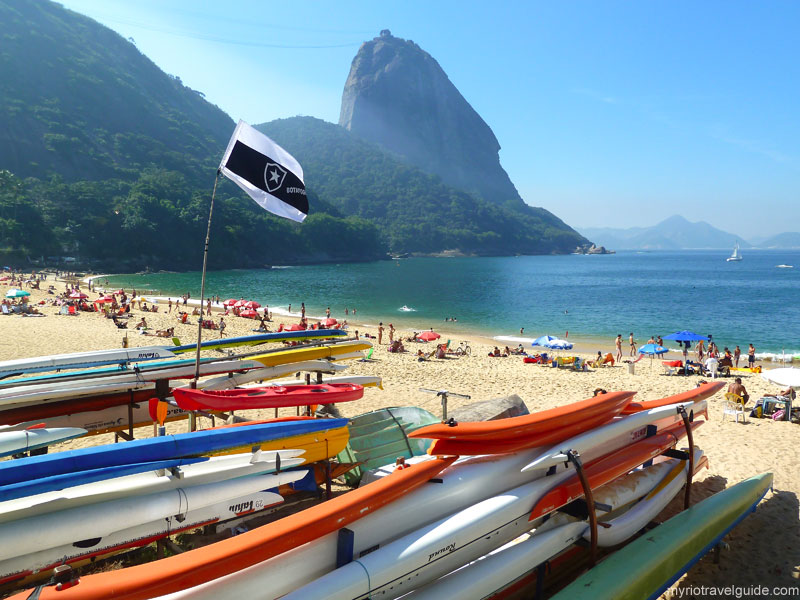 Vermelha Beach; view to Sugar Loaf.
Vermelha Beach is a small beach right next to Sugar Loaf. Despite its proximity to Sugar Loaf, very few tourists lounge on it. Here is a tip then: when visiting Sugar Loaf, bring along your swimming suit to take your time on this beach from where you can see the cable cars up and down Sugar Loaf.
Due to its calm water, Vermelha Beach is also popular for renting a canoe or a paddle board (the latter became extremely popular in Rio de Janeiro in the last years).
This beach is also popular with families with children. Beware that this small beach gets very busy on weekends and holidays, especially in the hotter months such as December, January, February and March. How to beat the crowd on such busy beach days in Rio? Get there by 8 a.m.
After or before Vermelha Beach, you can have lunch or dinner (and try food from Rio de Janeiro) at the restaurant Terra Brasilis, on the right hand side of the canoes you see on the photo above.
2. Leme Beach
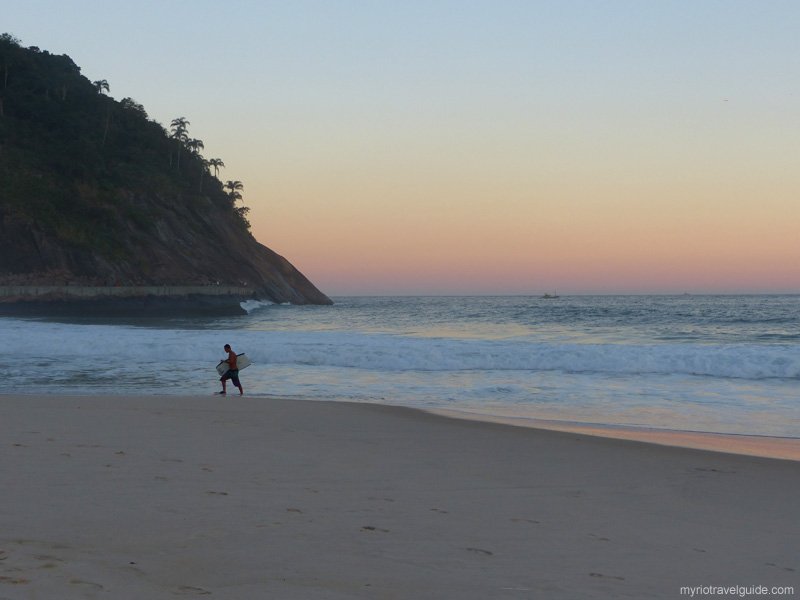 End of Leme Beach, near Leme Fort.
Leme is the beach right before Copacabana. There is no physical border between Leme and Copacabana Beaches — you can’t see where one starts and where finishes the other. In fact, many tourists who visit Rio de Janeiro choose a hotel in Leme as the difference between both beaches is almost non-existent.
Leme neighborhood is narrower than Copacabana — basically there is only one major street inland. It is definitely worth taking a walk at the residential inner streets of Leme. Very few tourists do it.
One of the highlights of Leme Beach is the fishing area at the very end of the beach (near Leme Fort; see photo), from where you can take great photos of Leme and Copacabana Beaches as well as of Christ the Redeemer, the iconic statue of Rio de Janeiro.
Just near the fishing area there is a place to practice cliff-jumping (extremely popular among children, teenagers and adults from the nearby favelas Babilonia and Chapeu Mangueira, especially on sunny and hot weekends or during the Brazil’s national school vacation months [December and January]).
Another highlight is Marius Restaurant/Steakhouse, expensive but worth-paying on special occasions for its all-you-can-eat steak and/or seafood.
3. Copacabana Beach
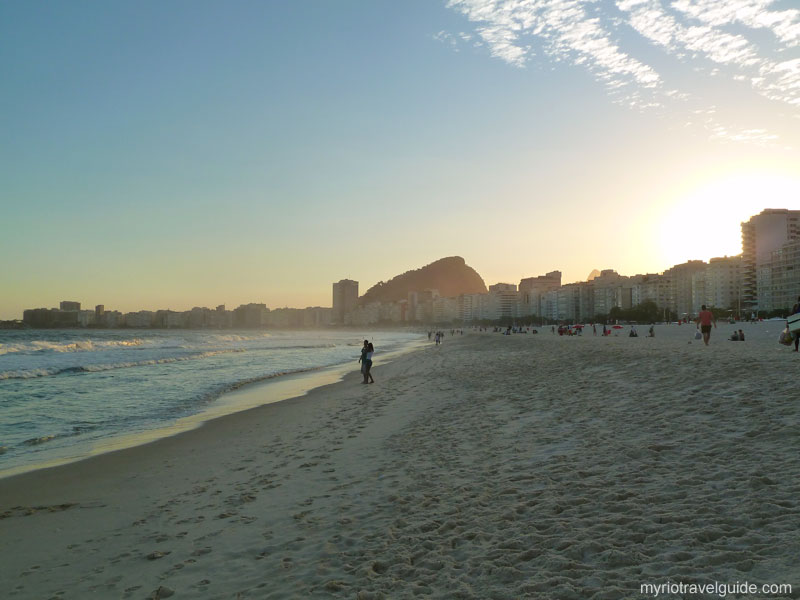 Very end of an afternoon on Copacabana Beach in Rio de Janero, Brazil.
Copacabana, which is 3 km long (almost 2 mi), is by far the most famous beach in Brazil. Every year, hundreds of thousands of tourists (Brazilians and foreigners alike) check Copacabana Beach out. This beach has many advantages:
- No matter where you stay in Copacabana, you are at maximum 15 minutes walking from the beach. Copacabana neighborhood is rather narrow, squeezed by mountains and by the beach.
- Copacabana neighborhood is narrow but long, home of more than 150,000 locals. In spite of the fact that most tourists stay in Copacabana, locals are the majority on the beach, especially on sunny weekends. Beach-going is one of Rio de Janeiro residents favorite past times.
- There are many things to do on Copacabana Beach and/or on its wide sidewalk: drinking, eating, walking, swimming, jogging, bicycling as well as playing sports such as beach football, volleyball and ‘footvolley’ (the latter is exactly like beach volleyball, but no hands allowed).
- On Copacabana Beach takes places one of the most amazing New Year’s Eve in the world, with 20+ minute long fireworks for an audience of more than two million spectators. New Year’s Eve and Carnival are the most popular events in Rio de Janeiro, attracting hundreds of thousands of visitors from Brazil and abroad.
- An unforgettable activity on Copacabana Beach is to witness the sunrise. Several local partiers do it on Saturdays and Sundays early morning after a full night out partying in Lapa neighborhood. Others see the sunrise almost everyday while exercising along Copacabana Beach.
4. Arpoador Beach
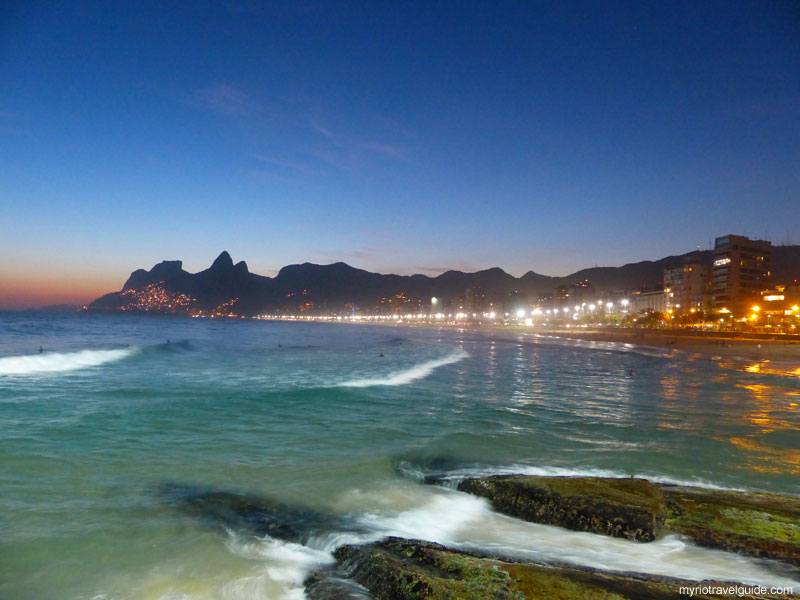 View from Arpoador Rock.
Arpoador is probably the third beach most visited by tourists as it connects both Copacabana and Ipanema neighborhoods. The highlights of Arpoador Beach are the sunset and the surfers (sometimes 20 to 30 surfers waiting for a wave at the same time!). By the way, here you can also take surfing lessons and join the crowd of Cariocas (natives of Rio de Janeiro).
Watching the sunset at Arpoador Rock is one of the most popular activities among local beachgoers, especially on Saturdays, Sundays, and holidays. Traditionally, locals applause the sun setting the very moment the sun sets.
Arpoador, Leme, Leblon, Ipanema, and Copacabana are the most popular beaches to hang out in Rio de Janeiro (and within walking distance from each other).
Since Arpoador Beach is rather small and well-lit at night, it is a popular spot for swimming at hot nights in December, January, and February.
5. Ipanema Beach
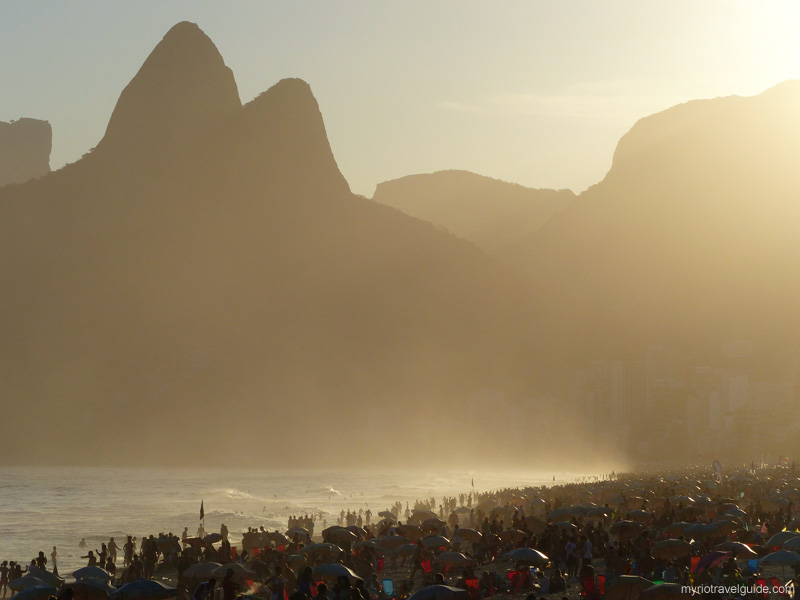 Ipanema Beach overcrowed on a hot Sunday; much emptier on weekdays though.
Ipanema Beach, which is only 600 meters (less than half a mile) from Copacabana Beach, is the second most famous beach in Brazil. Ipanema is a trendy and open-minded neighborhood, and so is Ipanema beach, with tanned, young and beautiful girls and boys from Ipanema.
One block inland from Ipanema Beach on Rua Vinicius de Moraes (Vinicius de Moraes street) is located Bar Garota de Ipanema (Girl from Ipanema Bar), where was composed the famous Brazilian bossa nova The Girl from Ipanema, which is the second-most recorded song in history.
Besides its historic side, one of the highlights of this bar is the grilled sirloin steak (grilled at your table), which is enough food for three persons (maybe four). Bear in mind that this bar/restaurant gets busy from 1 p.m. on weekends.
The most popular spot on Ipanema Beach is Posto 9 (life guard tower # 9). A few hundred meters away (right in front of Farme de Amoedo street) is the gay beach of Ipanema, always busy. The gay beach is easily identifiable due to the several rainbow flags planted in the sand.
Which is best: Copacabana or Ipanema Beach? I have met many visitors who prefer Copacabana Beach and many others who prefer Ipanema Beach; it’s a personal choice.
6. Leblon Beach
 Leblon Beach seen from H. Stern overlook
Leblon is the beach right next to Ipanema. If it wasn’t for a canal that separates both beaches, it would be hard to find the border between them, as they look pretty much the same. By the way, Leblon and Ipanema neighborhoods have the most expensive square meters in Rio de Janeiro (and among the most beautiful women and men in Brazil!).
Since Leblon has less hotels and self-catering vacation apartments than Ipanema and much less than Copacabana, beachgoers there are mainly locals.
A couple of blocks inland from Leblon Beach there are many great restaurants, especially on Dias Ferreira street, which is probably the most high-end restaurant row in Rio de Janeiro. If you love good food you can’t miss dining at least once at a restaurant on that street — they are all good but not cheap (Sushi Leblon, Zuka, Venga!, and others).
One of the highlights of Leblon is Mirante H. Stern (known as Mirante do Leblon). This a nice little overlook with a couple of cafés overlooking Leblon Beach. From it, you can also see Corcovado Mountain, Christ the Redeemer statue, Vidigal Beach, Sheraton Rio Hotel, the Two Brothers Hill, Ipanema Beach, Arpoador Rock, and the Cagarras Islands.
7. Sao Conrado Beach
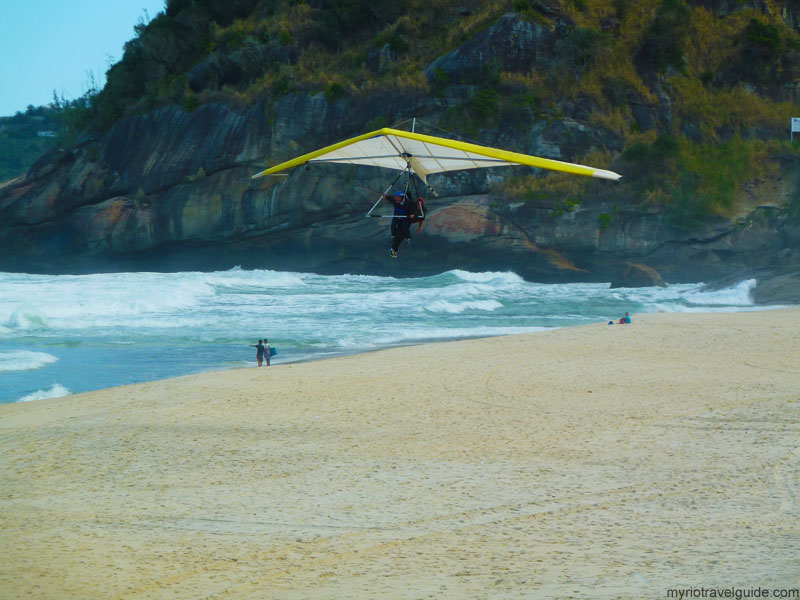 Hang-glider pilot landing on São Conrado Beach in Rio de Janeiro.
The uncrowded Sao Conrado Beach has an attraction that no other beach in Rio de Janeiro does — hang gliders landing on the sand. On a typical day with the right weather conditions you may see dozens of them landing right in front of you.
You can either lounge on the beach to watch all the landings or you can sit at a table at one of the small cafes on the sidewalk and watch them while sipping a coconut milk, a beer, a caipirinha, or an açaí (a Brazilian berry healthy smoothie).
On the spot you can also hire a pilot and fly in tandem. However, ideally you should book the hang gliding experience in advance with for example, Ricardo Hamond, one of the most experienced and reputable hang-glider pilots in Rio de Janeiro. He has been flying since 1987! If you fly, make sure to include photo and video in the price package.
Alternatively, you can do para gliding, which is a similar experience, but not the same.
Sao Conrado is a neighborhood of contrasts as it is home to the upscale Gavea Golf Club, the high-end Fashion Mall, and to Rocinha — one of the most famous favelas (shantytowns) in Rio de Janeiro and one of the largest in Brazil.
8. Barra da Tijuca Beach
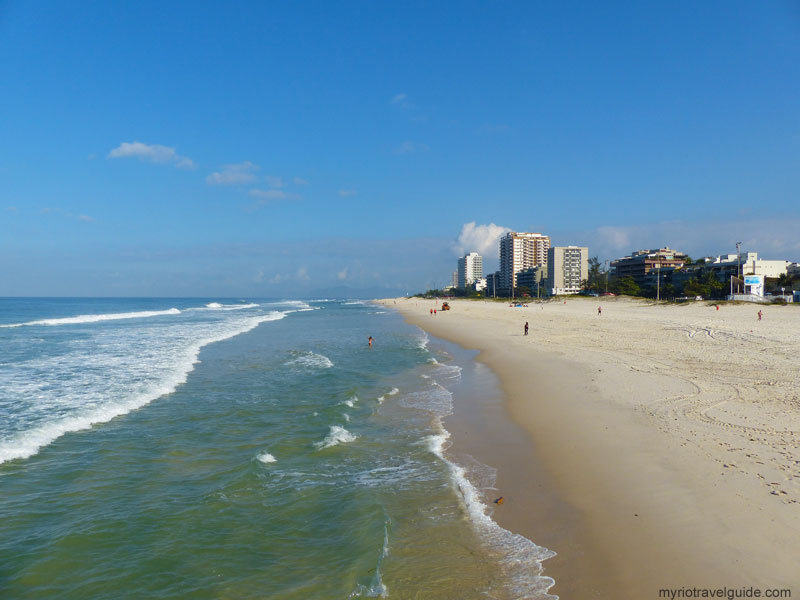 Barra da Tijuca Beach on a Monday morning.
Barra da Tijuca is a huge neighborhood in the West of Rio de Janeiro. Differently than Copacabana and its surrounding beaches, Barra da Tijuca Beach is extremely long. In fact, this beach is the longest in the Rio de Janeiro State.
The windy and white sand Barra da Tijuca Beach is in the favorite list of many locals in Rio de Janeiro. Besides, it is the best one for kite surfing in Rio.
The trendiest spot on Barra Beach is Pepê Beach, popular for its healthy sandwiches and the beautiful people who hang out in that area.
Barra Beach (short for Barra da Tijuca Beach) looks empty on the photo above because this picture has been taken on a Monday. On the summer weekends this beach gets busier but not as busy as Copacabana or Ipanema; Barra da Tijuca Beach has plenty of space along its 14 kilometres (9 miles).
Barra da Tijuca neighborhood is a bit out-of-the-way for tourists staying in a hotel in Copacabana, and even more for those staying in other neighborhoods such as Botafogo, Flamengo, Catete, Lapa, or Santa Teresa. That’s why is a good plan to take a day to combine Barra Beach with the other two beaches mentioned below: Prainha and Grumari (all three are located in the West of Rio).
Do you want to see Barra da Tijuca Beach from above? Hike to the summit of Pedra da Gavea (Gavea Rock) from where you can see great vistas.
9. Prainha
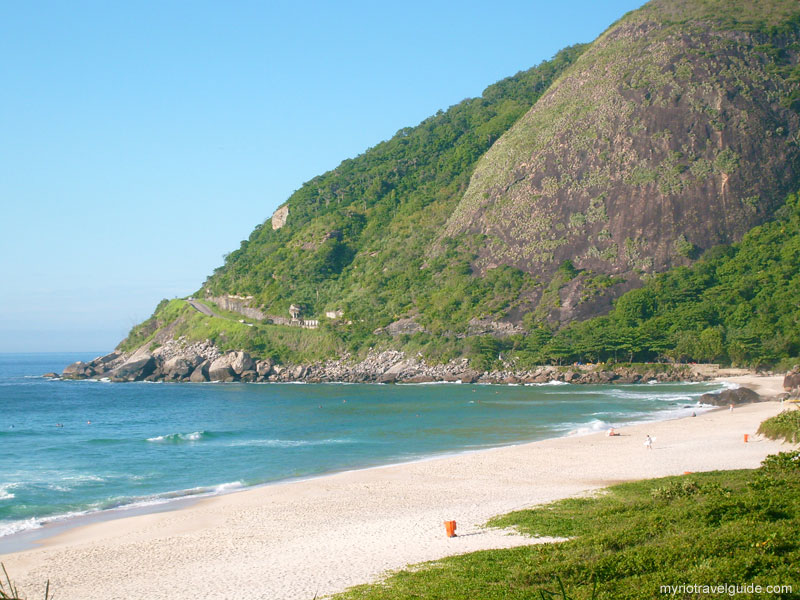 Prainha.
First of all, an important note about translation. The word “prainha” in Portuguese means “little beach”. So, it would be redundant so say Prainha Beach.
Prainha is the most popular beach for surfing in Rio de Janeiro. However, Prainha is approximately one hour by car from Copacabana, and since public transportation to this beach is non-existent, very few tourists get to visit it (except many Brazilian tourists who drive to Rio de Janeiro, and explore the city and its surroundings by car).
Both Prainha and Grumari (the one described below) are located in non-urban areas, but they are still in the perimeter of Rio de Janeiro city. Most foreigners get impressed by this small beach surrounded by mountains, far from residential and commercial areas.
If you like off the beaten path and lesser-known beaches, Prainha is a great choice. However, as it measures only 150 metres (490 feet), it does get busy on sunny summer weekends. For quietness and less traffic go on a weekday or early morning on a Saturday or Sunday.
10. Grumari Beach
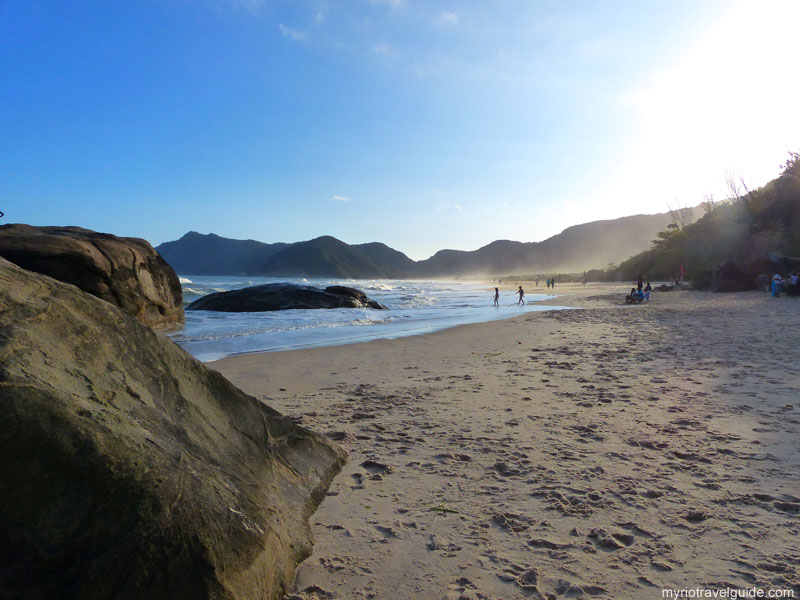 Grumari Beach.
Grumari is the beach right after Prainha, so even farther away from Copacabana. If you happen to visit Prainha, it worths driving three extra minutes to Grumari, where you can eat typical Brazilian dishes at one of the local restaurants, or take a sneak peek at Abrico Beach, which is the nudist beach nearby.
Grumari has almost the same length as Copacabana Beach, also surrounded by mountains, but with one key difference: no real state development.
If you are an independent traveler, a little bit adventurous, and like driving, it may pay off to rent a car in Copacabana and explore São Conrado, Barra da Tijuca, Prainha, and Grumari beaches on a single day. Alternatively, you can hire a taxi (on a flat-rate basis), a private tour guide with car, or arrange transportation through your hotel.
A warning about safety: it’s safe to go to beaches like Grumari on weekdays, however, as the beach is empty on weekdays stick to the area near the restaurants or cafés instead of isolating yourself in a deserted section of the beach. This advice is valid for many public areas in Rio de Janeiro — always stay near locals instead of completely by yourself in an isolated area. At night, avoid moonlit strolls by the waterline, which is deserted and dark on most beaches.
Conclusion:
From the beaches listed above seven are located near each other: Copacabana, Arpoador, Leblon, Ipanema, Leme, Vermelha, and São Conrado (the latter is a bit farther away from the other six). These seven beaches are located in the Zona Sul (Southern Rio de Janeiro).
The other three beaches (Barra da Tijuca, Prainha, and Grumari) are located in the Western Rio de Janeiro.
 Rio de Janeiro is not only about beaches: there are great restaurants and cafés, gardens, parks, monuments, historic neighborhoods, nightlife spots and more.
Get instant access to updated information in My Rio Travel Guide, the most practical travel e-book to Rio de Janeiro, Brazil. A must-have for the savvy traveler.
Click below to plan an awesome time in Rio de Janeiro!
