Safety in Rio de Janeiro favelas (slums) depends on many factors. Here is an overview of what makes a favela safe or dangerous. First of all, you need to understand that the authorities in Rio de Janeiro have decided to pacify several favelas in the city and make them safe areas. In other words, they have decided to bring to justice the drug lords and their personal armies from dozens of favelas until the Summer Olympic Games in 2016 (which,…read more
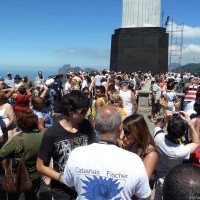
Getting to the top of Corcovado Mountain is becoming busier than ever. Literally every single tourist in Rio de Janeiro, Brazilian or foreigner, wants to see Christ the Redeemer statue from close as well as the breath-taking vistas from the Corcovado lookout. Here are the busiest times of the year to go up to Corcovado Mountain: Summer weekends in Rio de Janeiro Super long lines to visit Christ the Redeemer statue. You can avoid it with My Rio Travel Guide.…read more
There are many must visit places in Rio de Janeiro, more than a first-time visitor can possibly imagine. Places to visit in Rio go way beyond the traditional Copacabana Beach, Sugar Loaf, and Christ the Redeemer statue on Corcovado Mountain. Some tourists think that apart from those, there are only the Maracana Football Stadium, the Sambadrome, the Metropolitan Cathedral, and favelas. However, there are many other must visit places that will impress most visitors. Here are a couple of must-see…read more
There are countless reasons why you should visit Christ the Redeemer statue in Rio de Janeiro. The more appropriate question should, in fact, be not “why”, but “when” you should travel to Brazil and visit Cristo Redentor (Christ the Redeemer), among other marvelous attractions in Rio. There are several ‘whys’ you should visit the Jesus statue. Here are the top 5 reasons to visit Christ the Redeemer: Why # 1. Christ the Redeemer statue on the summit of Corcovado…read more
It is possible to tour Christ the Redeemer on Corcovado Mountain and Sugar Loaf Hill on a budget; there a few tour operators in Rio de Janeiro who offer such tours on 15-passenger minibuses, aimed at backpackers and the budget-conscious travelers. Typically, they pick up groups, couples and solo travelers in one or more hostels, and then finally proceed to visit Christ the Redeemer statue, a couple of other attractions (a favela, Sélaron steps, Santa Teresa, or the central area…read more
The Top 10 attractions in Rio de Janeiro are definitely a must-see. However, if you add the off the beaten path sites, Rio has way more than Top 10 attractions. In fact, Rio has dozens of great attractions, from natural sites to monuments to cafes to stadiums, and much more. As people have different interests, each local or visitor has his or her own Rio Top 10 personal list. Here are the attractions and things to do that are in…read more
It is of paramount importance to read insider’s Sugar Loaf tourist information before heading to the attraction. As a result of the popularity that Rio de Janeiro has been gaining in the last years as a travel destination, the number of tourists has been increasing steadily at all attractions, especially Sugar Loaf, the second most visited in Rio (the first is Christ the Redeemer on Corcovado Mountain). There are two major concerns a tourist should think of before visiting Sugar…read more
As far as go seeing Christ the Redeemer statue concerns, it is important to discern a cloudy day from a rainy day. In a lack of a blue-sky day, and pressured by the little time you as a visitor may have in Rio de Janeiro, you will probably need to go see the Jesus statue no matter the weather conditions. A rainy day is not necessarily a bad day to see Christ the Redeemer statue. On the contrary, it may…read more
Queuing up at the box office to get to Christ the Redeemer is not a myth. And lines sometimes are long, very long. The most visited monument in Rio de Janeiro is frequently beating its own record of daily visitors. World Youth Day (WYD), FIFA World Cup, Olympics Games combined with the booming Rio de Janeiro and Brazilian economy is and will keep attracting millions of tourists throughout 2014, 2015, 2016, and probably beyond that for many years. As a consequence,…read more
The four seasons in Rio de Janeiro (located in the Southern Hemisphere) are opposite to the seasons of the North Hemisphere. In other words, late December, January, February, and until late March is summer season. The climate is hot (approximately 32 c°/90 F°), and most of the time humid. Everybody is out, tourists and locals alike. Tourist attractions, beaches, nightlife venues, and other sites are rather busy. This is the tropical raining season — rains are usually short and strong…read more